The Practitioner Is Built Before the First Client
Jun 30, 2026
There's a quiet belief that runs through almost everyone learning this work: that you don't really begin until someone is sitting across from you. That practice only counts when it's live, when there are stakes, when there's a person in the chair waiting for you to be good. Everything before that — the reading, the rehearsing, the talking to yourself in an empty room — gets filed under getting ready. Not the real thing. A warm-up for the work that hasn't started yet.
It's a comforting idea, and it's wrong. The practitioner is built long before the first client ever arrives.
Erickson before he was Erickson
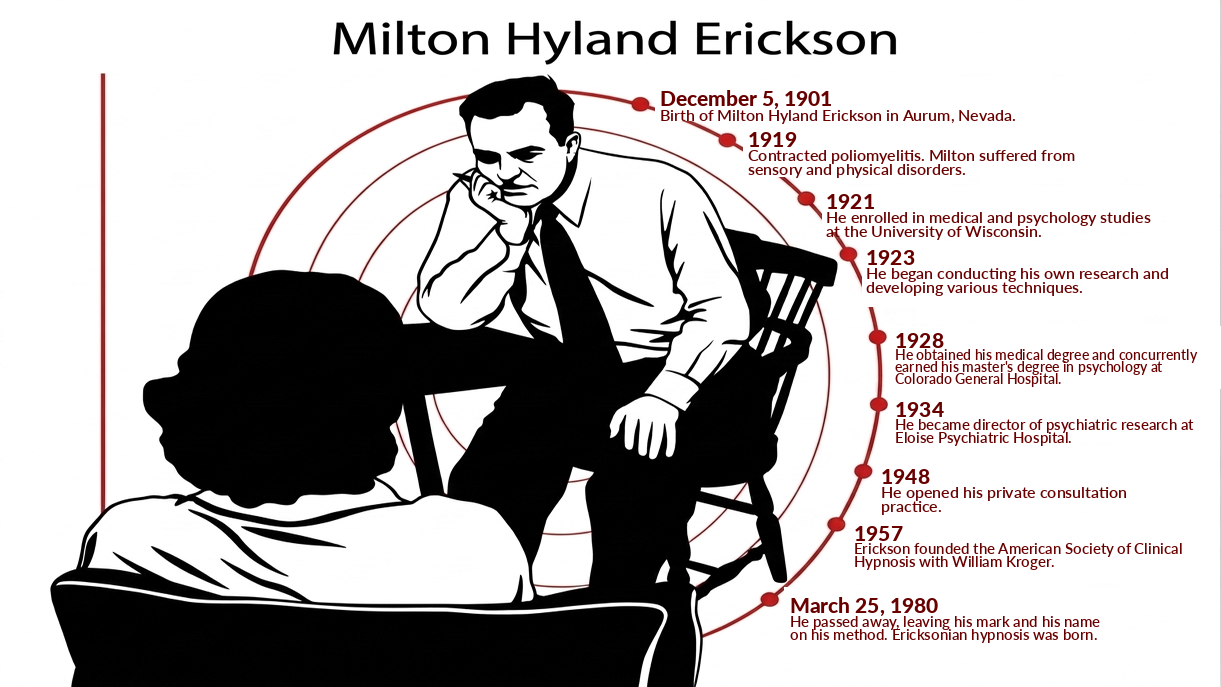
Milton Erickson is the name everyone reaches for in this field, and for good reason. But the man who became the most studied hypnotherapist of the twentieth century didn't start with patients. He started flat on his back.
At seventeen, polio left him almost completely paralysed. He couldn't walk. For a while he could barely move. What he could still do was pay attention — and so that's what he drilled. He spent long stretches watching his infant sister learn to stand and take her first steps, studying the exact sequence of tiny movements it took, then turning that attention inward and using memory and imagination to coax the same signals back into his own body. Slowly, he taught himself to move again.
In the same years, with nothing else available to him, he became a ferocious observer of people. Breathing. Muscle tone. The flicker of an eye. The tempo underneath someone's words. He had no clinic, no caseload, no reputation. He had attention and time, and he ground them into a skill.
By the point he finally had patients, the instrument was already tuned. The Erickson everyone studies was assembled in the quiet years, when nobody was watching and there was no one in the chair. The clients didn't make him. They met a man who'd already done the work.
Rehearsal is not the lesser practice
Here's the thing worth sitting with: for a craft built on language and attention, the reps you do alone aren't a pale imitation of the real practice. They are the practice. They're where the practitioner is actually forged.
A surgeon can't rehearse a real incision in their kitchen. But a strategic dialogue practitioner can run the whole shape of a session in their own head — and out loud, and on paper — as many times as they like. You can walk the phases. You can feel where one transitions into the next. You can hear where a piece of language lands cleanly and where it clatters. You can notice the exact moment a question stops being a question and starts doing something underneath. None of that needs a client. All of it makes you better for the one who eventually shows up.
This is the part people skip, because rehearsal feels like cheating. It's too low-stakes to count. But low stakes is precisely the point. Stakes don't teach you the moves; they only reveal whether you've learned them. The learning happens in the safe reps, the unglamorous ones, the ones nobody sees.
Reps are reps
I spent thirty-odd years in strength work before I ever spent a day in this one, and the principle carries straight across. You don't rise to the occasion. You fall to the level of your training. The lift you make under load on competition day is the lift you've already made a thousand times in an empty gym. The pressure doesn't add anything you didn't bring with you — it just strips away anything you faked.
The same is true here. The first client doesn't hand you fluency. They find out whether you have it. And the only way to have it is to have built it beforehand, in reps that didn't matter, done well enough and often enough that the method lives in your hands rather than in your notes.
So rehearse the dialogue. Speak it aloud to the wall. Run a simulated session and pay attention to where you fumble the sequencing. Drill the phases until you can feel them turning over without thinking. Do it on the days when there's no one to impress and no reason to bother. Those are the days that make you.
Do the work before the work
The chair is the test, not the training ground. By the time someone's sitting in front of you, the part that builds you is already behind you.
That's not a reason to wait until you feel ready — you'll never feel ready, and readiness isn't the point. It's a reason to take the solitary work seriously now, to treat the empty-room reps as the real thing, because they are. Every practitioner you admire was made in those hours. Erickson was. The good ones still are.
Reps are reps. Do them, and the chair will be waiting when you're ready to sit down across from it.
Strategic Dialogue Hypnotherapy is a question-led method of change work where trance is the byproduct, not the treatment. If you want a place to begin the reps, start here: The 5 Question-Led Shifts — a free guide to the questions that help clients stop fighting themselves.
Author