The Art of Priming: Why Preparation Shapes Everything
Jul 06, 2026
Here's something most people never notice, but it runs quietly beneath nearly every meaningful interaction they'll ever have.
Priming.
It's one of those words that gets thrown around in psychology and coaching circles, but rarely explained in a way that actually lands. So let's strip it back and answer the real question first.
What the Hell Is Priming?
At its simplest, priming is preparation.
It's the setting of expectation before the moment arrives. It's what happens before the thing you actually want to happen — the groundwork that makes the real work possible.
Think of priming a pump. Before the water flows, you have to prime it. Think of priming a wall before you paint — skip it, and the colour never holds. Think of a musician warming up before they perform, or a fighter shadowboxing before they step into the ring. None of that is the main event. All of it determines how the main event goes.
Priming is the invisible layer of readiness. And once you see it, you can't unsee it.
Priming in the Therapy Room
In a hypnotherapy session, priming is everything.
You don't just drop someone into deep change work cold. That's amateur hour — and it doesn't work. Instead, you prepare them. You shape the expectation of what's coming. You let their nervous system know, at a level far below conscious thought: You're safe. This is going to work. Something is about to shift.
This starts long before any formal technique. It starts in the first phone call. It's in the tone of your voice, the confidence in how you describe the process, the way you frame what's possible. By the time the person is sitting across from you, they've already been primed to expect change — or they've been primed to expect disappointment. Either way, you set it.
Then within the session itself, every stage primes the next. The conversation primes the investigation. The investigation primes the intervention. Nothing lands in isolation. By the time the actual change work arrives, half the job is already done — because the person was prepared to receive it. The soil was tilled before the seed went in.
Skip the priming and you're pushing against resistance the entire way. Prime well, and change feels almost inevitable. Not because you forced it, but because you built the conditions for it to happen naturally.
But Priming Isn't Just a Therapy Thing
Here's where it gets genuinely interesting.
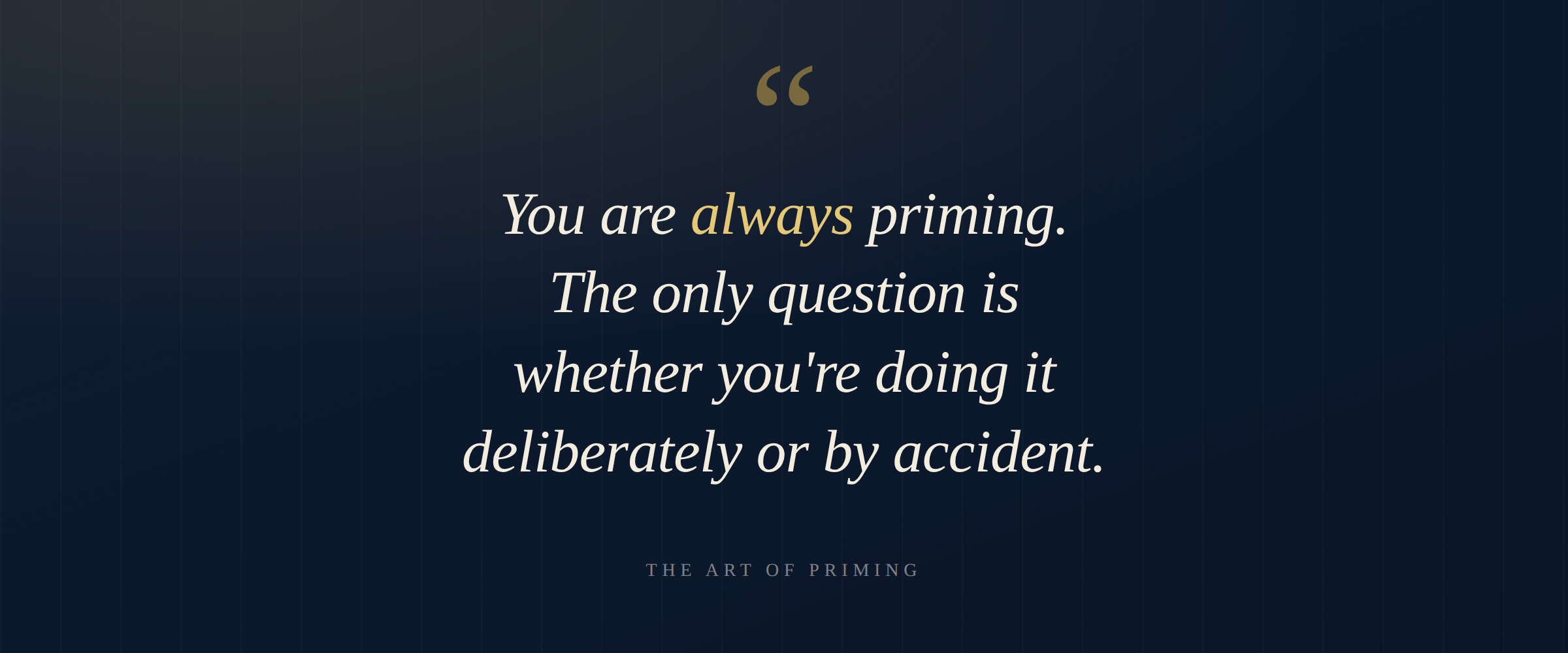
Priming isn't confined to the consulting room. It's woven through the whole of life. Every single day, in every interaction, you are priming — or being primed. The only question is whether it's happening deliberately or by accident.
Before a difficult conversation. The tone you set in the first ten seconds primes how the entire exchange unfolds. Walk in tense and defensive, and you've primed a fight. Walk in warm and open, and you've primed a resolution. The words you use afterwards matter far less than most people think. The frame you set first matters far more.
Before a workout. How you talk to yourself walking into the gym shapes what your body is willing to give you. Prime yourself with "I'm exhausted, this is going to be rough" and your body obliges. Prime yourself with intention and focus, and you'll surprise yourself with what shows up.
Before you step on stage. The breath, the intention, the story you tell yourself in the wings — that primes the performance before you've sung a single note. Performers who fall apart on stage usually fell apart in the priming, long before the spotlight hit.
Before you ask someone for something. The warmth and context you build first determines whether they say yes. Lead with the ask and you trigger resistance. Prime the relationship, prime the moment, prime the readiness — and the yes comes easily.
Before you learn something new. Even learning is primed. Approach a new skill believing you're "just not a natural" and you've capped your ceiling before you began. Prime yourself for curiosity and patience, and the same skill opens up.
You are always priming. You cannot switch it off. You can only choose to do it well.
The Real Lesson
Whenever you want someone to implement something — a new idea, a change, a decision, a behaviour — the mistake almost everyone makes is going straight for the ask.
They lead with the request. They deliver the technique. They push the outcome. And then they wonder why it meets resistance.
The skill is in the preparation. Prime the ground first. Build the expectation. Make the moment ready. Whether you're a therapist guiding a client, a coach developing an athlete, a leader steering a team, or simply a person trying to have a better conversation with someone you love — the principle is identical.
The person in front of you can only meet you as far as you've prepared them to.
That's true in the therapy room. It's true on stage. It's true in the gym, the boardroom, the kitchen table conversation. It's true everywhere.
Start Noticing It
For the next week, watch for priming everywhere. Notice how you prime yourself before hard tasks. Notice how skilled people prime the room before they speak. Notice the moments where something worked beautifully — and trace it back to the preparation that made it possible.
Then notice the moments things fell flat, and ask the honest question: was the outcome the problem, or was it the priming?
Master this one principle, and everything downstream gets easier.

Prime well — and the rest takes care of itself.
Author